Forces 50N and 80N act on a body as shown in the diagram....
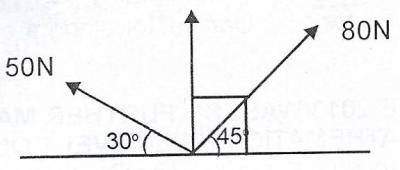
Forces 50N and 80N act on a body as shown in the diagram. Find, correct to the nearest whole number, the horizontal component of the resultant force.
13N
43N
57N
95N
Correct answer is A
Given a force F, the horizontal component = \(F\cos \theta\)
R = \(-50\cos 30 + 80\cos 45\)
= \(-50(\frac{\sqrt{3}}{2}) + 80(\frac{\sqrt{2}}{2})\)
= \( -25\sqrt{3} + 40\sqrt{2} = -43.30 + 56.67 \)
= \(13.37N \approxeq 13N\)
Similar Questions
If (2t - 3s)(t - s) = 0, find \(\frac{t}{s}\)...
If \(\frac{15 - 2x}{(x+4)(x-3)}\) = \(\frac{R}{(x+4)}\) \(\frac{9}{7(x-3)}\), find the value of...
The distance between P(x, 7) and Q(6, 19) is 13 units. Find the values of x. ...
A particle moving with a velocity of 5m/s accelerates at 2m/s\(^2\). Find the distance it cover...
A force of 230N acts in its direction 065\(^o\). Find its horizontal component....
Find the radius of the circle 2x\(^2\) - 4x + 2y\(^2\) - 6y -2 = 0. ...
Find the 21st term of the Arithmetic Progression (A.P.): -4, -1.5, 1, 3.5,... ...