
Physics Questions and Answers
If you want to learn more about the nature and properties of matter and energy or you're simply preparing for a Physics exam, these Physics past questions and answers are ideal for you.
If you want to learn more about the nature and properties of matter and energy or you're simply preparing for a Physics exam, these Physics past questions and answers are ideal for you.
has three pro tons and two neutrons
has two protons and one neutron
has two protons and three neutrons
has one proton and two neutrons
cannot exist because it has the same mass number as tritium
Correct answer is E
No explanation has been provided for this answer.
Bqv
Bq\(\frac{v}{m}\)
Bqvm
mv\(\frac{B}{q}\)
\(\frac{mv}{Bq}\)
Correct answer is A
The formula for Force on the particle is Bqv.
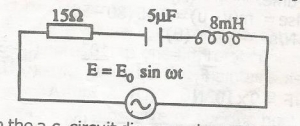
In the AC circuit diagram above, the resonance frequency is
5000π Hz
2500π Hz
5000/π Hz
2500/π Hz
Correct answer is D
No explanation has been provided for this answer.
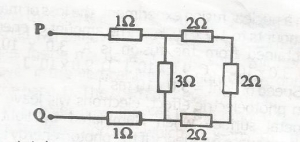
The total resistance measured at PQ in the diagram above is
18.0Ω
11.0Ω
4.0Ω
2.0Ω
Correct answer is C
The three 2 ohms are in series, therefore the total resistance is
\(R=R_1+R_2+R_3\)
\(R_ {total} =2+2+2= 6\) ohms.
resketching circuit;
6 ohms is used to replace the three 2 ohms which is therefore placed by the 3 ohms resistor.
The 3 ohms and 6 ohms resistors are in parallel, so the combined resistance is
\(R=\frac{R_1xR_2}{R_1+R_2}\)
\(R= \frac{3×6}{3+6}\)
\(R=\frac{18}{9}=2\) ohms.
Resketching circuit:
The 2 ohms is used to replace the 3 ohms and 6 ohms laying side-by-side.
Therefore, the 3 resistors (1 ohm, 1 ohm, and 2 ohms) are in series.
Thus, the total resistance is
\(R= (R_1+R_2+R_3)\)
\(R_{total} =1+1+2=4\) ohms.
Therefore, the total resistance measured at PQ is 4 ohms.
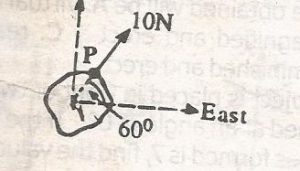
5N in the direction of east
5N in the direction of west
5V3N in the direction of west
10N in the southwest direction
Correct answer is B
The horizontal (eastward) component of the 10N force is = 10 cos60
→ 10 x 0.5 = 5N.
The equilibrant force needed to stop the body moving eastward must act in exactly the
opposite direction.
Therefore, the needed force is 5N in the direction of West